
Contract Risk Management: Definition, Best Practices and Key Benefits
11/02/2022
11 min read

Every contract carries risk. How you manage it determines whether it becomes a liability or a lever for growth. Without the right process and tools, missed obligations, compliance gaps, and financial leakage compound silently until they become costly problems.
In this guide, we cover the most common contract management risks, a proven five-step process for managing them, and the best practices to keep your business in control.
Key highlights:
- Contract risk management is the process of identifying, assessing, and mitigating potential liabilities across every business agreement before they escalate into financial, legal, or operational problems.
- Common contract management risks include data leakage, compliance failures, financial losses, and operational delays.
- A structured five-step framework provides legal and procurement teams with a repeatable process to control risk throughout the full contract lifecycle.
- Conga CLM centralizes your contract portfolio, automates compliance workflows, and surfaces risk in real time, giving your team the visibility and control needed to protect revenue at every stage.
What Is Contract Risk Management?
Contract risk management is the strategic process of identifying, assessing, and mitigating the potential liabilities inherent in every business agreement. While risk is a natural part of any deal, the goal of management is to neutralize exposure and protect your margins before they are compromised.
In practice, this involves using digital contract risk assessment tools to quantify the specific level of risk within a single contract. While the legal team typically leads this management process, it requires seamless collaboration with sales and operations to ensure the entire commerce chain remains aligned and profitable.
Benefits of Effective Contract and Risk Management
An effective contract risk management process protects revenue, reduces exposure, and improves operational control. By standardizing processes and increasing visibility, you prevent costly issues from escalating and ensure that contracts deliver the expected value. Benefits include:
- Protect assets and reputation. With a risk management approach, you address potential vulnerabilities before they escalate into costly disputes or regulatory non-compliance issues.
- Contributes to operational excellence and cost savings. By streamlining contract processes, reducing errors, and minimizing disruptions, you optimize resource allocation and enhance overall productivity.
- Foster trust and transparency in business relationships. When stakeholders are confident that they are managing contracts with integrity and diligence, it strengthens partnerships and encourages collaborative efforts towards mutual success.
- Capitalize on opportunities for growth and innovation. By minimizing uncertainties and maximizing value from contracts, you seize new market opportunities, drive strategic initiatives, and stay ahead of the competition.
Types of Contract Risk in Deal Management
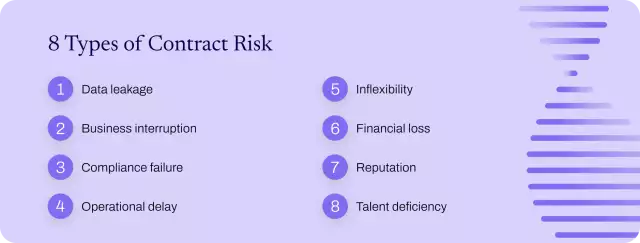
Complacency leaves your organization exposed to human error, financial loss, and reputational damage. To manage it well, you first need to know where it comes from. Here are the common contract risk factors many industries face:
1. Data leakage
Fragmented storage shatters your security posture. When your team scatters contracts across shared folders, emails, and paper files, it invites data leakage due to simple oversight. The financial stakes are high: IBM reports the global average cost of a data breach reached $4.44M, with U.S. companies hitting a record $10.22M per breach.

A single, secure contract repository prevents these leaks, ensuring you maintain regulatory compliance and protect your most sensitive data without compromising deal velocity.
2. Business interruption
Most procurement functions bear responsibility for ensuring that the company’s suppliers provide a steady stream of production inputs. To satisfy this requirement, you need to call upon a system capable of monitoring its supplier feeds. If a supplier fails to deliver, what is the fallback? And can procurement detect early warning signs of imminent failure?
Without the right contract lifecycle management (CLM) system, you are at significant risk of breakdowns that could, at worst, shut down a factory and cost sales.
3. Compliance failure
Regulatory oversights derail profitable growth. Operating without an enterprise CLM system creates a blind spot, hiding applicable regulations and blocking critical audits. Automated tracking provides the transparency needed to manage contract risk and compliance. This proactive oversight protects your margins and reputation from the steep costs of avoidable regulatory failure.
4. Operational delay
Procurement’s mandate is to follow the right process without creating undue delay. However, slow contracting cycles due to outdated technology can mean you have to wait to obtain a much-needed product or service. Such a setback can materially impact your company’s growth capabilities and future earnings.
In fact, it can put your business in a reactive mode when responding to operational vulnerabilities, rather than a proactive mode to capitalize on prime opportunities.
5. Inflexibility
A top priority of modern CPOs is to support greater business agility: creative purchasing agreements, faster purchasing, conditional sourcing arrangements, etc. Without the right contract risk management tools, this type of agility isn’t possible. In turn, you risk being unable to introduce new products and new sales channels, or enter new markets.
6. Financial loss
When you are purchasing hundreds of millions of dollars' worth of supplies, even missing a small percentage of potential savings can add up to big dollars. Well-managed agreements ensure that procurement is aware of its financial obligations, including payments due, service levels, rebates, and discounts. However, manual contract management methods lead to financial leakage in procurement.
7. Reputation
Friction-filled processes brand your company as hard to do business with, repelling elite suppliers, partners, and talent. Contract management technology transforms procurement into a transparent, streamlined experience, simplifying every interaction. By removing the barriers to collaboration, you position your organization as a partner of choice and ensure your commerce ecosystem moves at the pace of opportunity.
8. Talent deficiency
Outdated contract and procurement processes make it harder to attract and retain top talent. Today’s professionals expect digital-first tools, and organizations that lag behind struggle to compete. Deloitte’s 2025 Global CPO Survey identifies digital literacy as a core competency and shows that organizations investing in both technology and talent outperform peers—96% of leaders meet or exceed cost-savings targets.

Without modern systems, you risk lower productivity, reduced engagement, and a widening talent gap.
The Contract Risk Management Process: A 5-Step Framework
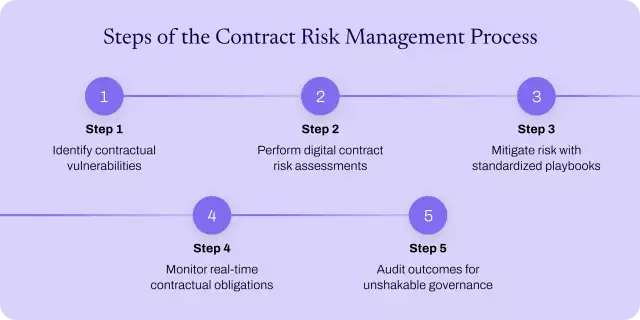
Managing risk works best when you follow a clear process. This five-step framework helps you spot threats, put controls in place, and keep track of contracts from start to finish.
1. Identify contractual vulnerabilities
Begin by checking all your agreements, including old contracts, current documents, and new third-party papers, for unclear terms, missing sections, undefined duties, and unusual wording. Manual reviews often overlook hidden risks in large groups of contracts.
AI-powered contract analysis tools, such as Conga Contract AI, can quickly spot differences from approved templates, risky wording, and expired terms in thousands of documents at once. Finding these issues early helps you avoid legal problems, lost money, and extra work during negotiations.
Gain instant visibility into contract risk with Conga
2. Perform digital contract risk assessments
After you identify the risks, rate each contract based on factors such as financial risk, compliance requirements, counterparty risk, and obligation complexity. CLM platforms can automate this by using set rules for every deal, so you get a data-driven contract risk analysis instead of relying on personal judgment.
This scoring system helps legal and procurement teams focus on high-risk contracts right away, while moving low-risk ones through the approval cycle, reducing delays without sacrificing oversight.
3. Mitigate risk with standardized playbooks
Neutralize exposure before signature by enforcing standardized templates, clause libraries, and negotiation playbooks. Define pre-approved language for critical terms such as liability and indemnity to remove guesswork from high-velocity deals.
Contract management tools can automatically spot differences, help teams select approved backup options, and route exceptions through predefined approval steps. When sales teams can create compliant agreements on their own, negotiations move faster, and your business can keep up with new opportunities.
4. Monitor real-time contractual obligations
Deal execution marks the starting point for active contract obligation management. Monitor commitments by deploying automated alerts and live dashboards to track critical milestones, price escalators, and SLAs in real time.
With this ongoing visibility, you don’t have to rely on manual checks. You’ll catch every renewal and required price change. This type of contract automation helps you manage risk, stay compliant, and protect your margins after signing.
5. Audit outcomes for unshakable governance
Regular audits ensure you meet your obligations, your controls work, and you handle risks consistently. Legal and compliance teams should review signed contracts for discrepancies, recurring risks, and gaps in the process.
CLM platforms can automate this by creating audit trails, contract compliance reports, and performance analytics, giving leaders a clear view of all contracts. This documentation helps with regulatory compliance, supports dispute resolution, and improves risk standards and playbooks for future deals.
Explore the best types of contract management dashboards.
Strategic Best Practices for Contractual Risk Management
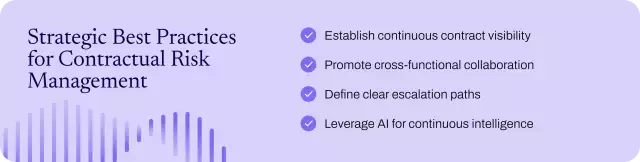
Managing agreement risk requires transparency, cross-functional collaboration, and the right technology. Follow these best practices to reduce exposure and maintain control across the contract lifecycle:
1. Establish continuous contract visibility
Without a centralized repository, critical agreements live in shared folders, inboxes, and local drives. You should consolidate all contracts into a single, searchable system that provides legal, procurement, and finance teams with real-time access to the full portfolio and the contract performance data they need.
This visibility enables faster risk identification, stronger compliance oversight, and better decision-making across every stage of the contract lifecycle.
2. Promote cross-functional collaboration
To foster effective communication and collaboration, you should establish regular meetings or check-ins involving all relevant stakeholders, including legal teams, procurement professionals, finance departments, and contract managers.
Additionally, leveraging collaborative tools and technologies, such as shared document repositories or project management platforms, can facilitate real-time collaboration and streamline communication channels. By encouraging open dialogue and constructive feedback, you identify potential risks early on and implement proactive measures to address them effectively.
3. Define clear escalation paths
Establishing clear escalation procedures is important for addressing and resolving issues or disputes that arise during the contract lifecycle. Clear escalation procedures:
- Define a structured approach for identifying issues that warrant escalation
- Designate individuals or teams responsible for overseeing the escalation process
- Establish a hierarchical framework for escalating issues to higher levels of authority
By establishing these escalation processes, you can manage contract risks, mitigate potential disputes, and maintain positive relationships with stakeholders.
4. Leverage AI for continuous intelligence
Purposeful AI transforms contracts from static documents into actionable data. By embedding contract intelligence into the commerce chain, legal and procurement teams automatically identify non-standard language and regulatory deviations across high-volume portfolios. This integration creates a single source of truth for total visibility and accurate reporting.
Conga CLM enforces compliance through automated workflows and centralized clause libraries. Our platform ingests third-party paper and maps it against approved legal standards, eliminating the manual bottlenecks that stall deal cycles and revenue flow.
AI contract review software provides:
- Automated data extraction: surface hidden terms and obligations across all contracts
- Third-party ingestion: automatically identify deviations from internal standards in external documents
- Risk scoring: evaluate liabilities at scale to prioritize high-risk agreements for review
- Standardized guardrails: apply approved templates to maintain enterprise-wide consistency
Control Contract Management Risks with Conga CLM
When you manage contract risks well, you can turn possible problems into opportunities for growth. The Conga Contract Lifecycle Management Platform brings all your contracts together in one place, giving you real-time insight to spot issues and keep your business on track.
You replace manual reviews with AI-powered intelligence and automated guardrails, you eliminate the revenue friction zone, and protect your margins from post-signature decay. Empower your legal and revenue teams to navigate complex commerce ecosystems with absolute confidence.
Contact our sales team today to gain a revenue advantage and ensure your organization moves at the pace of opportunity.
Reduce contract risk and protect revenue with Conga CLM.
Frequently Asked Questions
-
What is a risk management agreement?
A risk management agreement is a contract that explains how parties identify, share, and handle risks in a business relationship. It covers each party’s responsibilities, liability limits, indemnification, and dispute resolution. This deal helps both sides understand their risks before signing.
You can use risk management agreements to protect assets, enforce compliance, and establish clear accountability across the contract lifecycle.
-
How do you reduce risk in contract management?
To reduce contract management risks, follow these steps:
- Centralize all agreements into a single repository to eliminate data silos.
- Deploy standardized templates and clause libraries to remove ambiguity during the drafting phase.
- Use AI-powered contract risk analysis to score liabilities and flag non-compliant terms automatically.
- Automate obligation tracking and renewals to prevent post-signature financial leakage and ensure continuous contract risk and compliance.
Conga CLM brings all of these capabilities into a single platform, centralizing your portfolio, enforcing standardized templates, automating compliance workflows, and tracking obligations in real time. From first draft to renewal, our solution gives your legal and procurement teams the visibility and control they need to reduce contract management risks at every stage.
Learn how tomaster CLM best practices to reduce your contract risks.
-
Why does the risk management team review contract details?
Risk management teams scrutinize contract details to identify legal, financial, and operational exposure before signature. They validate the clause accuracy and assess counterparty risk to prevent costly disputes and regulatory penalties. This proactive review protects margins and reputation by neutralizing unfavorable obligations, such as ambiguous indemnity or uncapped liability, helping to ensure that every agreement aligns with enterprise risk tolerance.
-
Where can you find contract management programs with risk mitigation strategies?
Find contract management programs with risk mitigation strategies in modern CLM platforms like Conga CLM. Our solution integrates:
- AI-powered contract risk assessment
- Automated contract approval workflows
- Real-time obligation tracking into a unified data model
Conga provides the end-to-end visibility required to standardize legal frameworks, manage compliance at scale, and maintain auditable governance across the entire revenue lifecycle.
Related Resources
-
The Quote to Cash Process in 10 Steps BlogCLMThe Quote to Cash Process in 10 Steps
Discover how to streamline your quote-to-cash (Q2C) process to accelerate sales cycles, improve customer experience, and boost revenue. This comprehensive guide covers every stage—from configuration and pricing to contract management, billing, and renewals—plus tips for finding the right automation solution. Learn how to eliminate silos, reduce errors, and drive efficiency across your CRM and ERP systems.12/01/20259 min read -
Pricing Opportunity Framework: See What You’re Leaving on the Table GuidesAIPricing Opportunity Framework: See What You’re Leaving on the Table
Estimate how much revenue your pricing process is losing and what it would take to recover it.03/30/20263 min read -
Reimagine Commerce and Profitability with Conga on the Microsoft Azure Marketplace BlogAIReimagine Commerce and Profitability with Conga on the Microsoft Azure Marketplace
Discover Conga's AI-powered CPQ, CLM, Document Automation, and Pricing Optimization solutions now available on Microsoft Azure Marketplace.10/06/20266 min read -
Connect and Learn With Peers in the Conga Customer Community BlogCLMConnect and Learn With Peers in the Conga Customer Community
Join 40,000+ peers in the Conga Customer Community—connect, learn, and grow with resources, training, and support to fuel smarter business outcomes.09/30/20266 min read