The 2026 Revenue Leakage Analysis: A CFO’s Guide
06/29/2026
13 min read

At every month-end close, bookings and realized margin tell two different stories. We call this gap between them revenue leakage, and it shows up as mispriced quotes, contract terms that never reached billing, rebates calculated against the wrong volume, and discounts approved outside policy. None of it looks like a problem in isolation, but the cumulative effect across a fiscal year runs into millions for most enterprise B2B businesses.
For CFOs, that gap stopped being a back-office reconciliation problem. Revenue leakage is now a P&L credibility issue that auditors flag, boards question, and aggressive growth targets refuse to absorb.
Let's review six analytics steps to surface hidden leaks, the metrics all finance leaders should track, and the technology stack that closes these gaps for good.
Key highlights:
- Revenue leakage is income lost due to gaps in billing, pricing, contracts, or processes.
- A revenue leakage audit exposes pricing misalignment, contract non-compliance, and disconnected systems as compounding sources of margin loss.
- Conga pairs configure, price, quote (CPQ), contract lifecycle management (CLM), pricing analytics, and billing systems on one connected platform to prevent financial losses.
What Is Revenue Leakage?
Revenue leakage is when a business loses revenue it has earned or can contractually claim because pricing errors, billing gaps, contract mismanagement, process inefficiencies, or oversight prevent it from capturing it. This disconnect surfaces through unbilled services, underpriced quotes, or untracked usage that slips through fragmented systems.
CFOs and CROs often struggle with these execution gaps, where manual billing errors and expired discounts erode margins and sabotage profitable growth. In fact, according to our report in partnership with Ascend2, 35% of executives identify leakage as the most significant consequence of mismanaging the revenue process.

Most leakage doesn’t trace back to one failure. The root cause is almost always that contract information lives across PDFs, email threads, and spreadsheets instead of as structured information in a single system of record.
Why You Need to Conduct a Revenue Leakage Analysis
The C-suite expects CFOs to demonstrate end-to-end revenue control, not just reporting accuracy. That means knowing how your team sets prices, applies discounts, enforces contracts and negotiated terms, and realizes total revenue across your systems. Without that visibility, revenue leakage becomes an invisible tax on growth: quietly undermining profitability even as topline numbers appear healthy.
Disconnected technology now drives most of the loss. Forrester found that 46% of revenue operations leaders say their processes are mostly manual. Spreadsheets, email-approved discounts, and offline contract amendments make the official number drift from the executed gains.

See these reasons why you need a revenue leakage analysis:
- Compliance exposure is rising: gaps in discount approval policies, pricing guardrails, and contract term enforcement create direct integrity risk that reaches the board
- Manual processes bleed money: revenue operations leaders say their processes aren’t flexible enough to respond to changing market conditions, and leakage compounds faster than teams can catch it
- CFOs need governance, not audits: leading finance leaders treat revenue leakage analysis as an ongoing process, connecting pricing, contracts, and billing into a unified commerce chain to move from reactive reconciliation to proactive control
- A structured audit creates clarity where it matters most: a leakage analysis tells you how much revenue you’re losing, where it’s leaking, and what it would take to close the seams
Main Causes of Revenue Loss in Enterprises
Revenue loss in enterprise B2B businesses concentrates in four patterns:
- Pricing misalignment and discount execution gaps across the quote-to-cash process: sales reps quote from price books that lag current cost inputs, so by the time the variance hits gross margin, the quote is months old, and you have already lost the revenue
- Contract non-compliance and unenforced commercial terms: finance negotiates volume commitments, price escalators, renewal terms, and service-level agreement (SLA) penalties into contracts, but none integrates into billing, so the year-two price escalator never fires because information runs from separate systems
- Data gaps between CRM, CPQ, and invoicing systems: mismatched accounts, unsynced stock keeping units (SKUs), and missing usage records create errors that compound until teams reconcile them
- Thin compliance coverage: 54% of respondents in EY research say employees not understanding policies, combined with limited compliance resources, creates openings for integrity breaches, which can show up as off-policy discounts, skipped approvals, and leakage
An integrated configure, price, quote process addresses all these causes at the source of revenue leakage: it enforces real-time pricing guardrails, feeds negotiated contract terms into billing, and maintains a single governed data model across CRMs and CPQs.
How to Identify Revenue Leakage Using Analytics in 6 Steps
A six-step analytical sequence turns a hunch about margin compression into a defensible audit to identify revenue leakage.
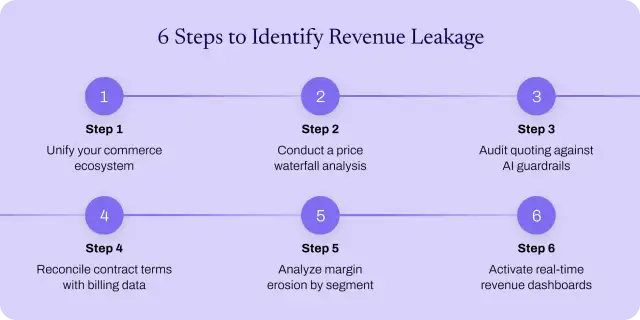
1. Unify the commerce ecosystem within a single source of truth
The first step in any revenue leakage analysis is to consolidate CRM, CPQ, CLM, billing, and ERP data into a single governed model. The leak only surfaces when the four datasets sit side by side at the account, contract, and SKU level.
Instead of tearing out your existing infrastructure, you can keep your existing systems of record where they are and layer on a unified platform that connects the entire business. Conga CPQ consolidates all commercial signals into a single data model, creating a flow from quote to cash.
2. Conduct a price waterfall analysis to expose pricing execution gaps
A price waterfall walks each deal from list price to net realized price, capturing adjustments such as standard discounts, volume tiers, deal-desk approvals, rebates, payment terms, and one-off concessions. The output shows where the published pricing strategy and actual execution diverge.
These are common examples of revenue leakage tied to pricing execution and how to solve them:
| Example of Revenue Leakage | How to Solve |
| Discount stacking exceeds policy floors | Tighten approval workflows and enforce pricing guardrails at the quote stage |
| Rebate accruals applied to the wrong account hierarchy | Re-price the accrual base and align account structures across your systems |
| Post-deal concessions logged as service credits | Move credits into the pricing engine so all concession routes go through a governed process |
3. Audit quoting behavior against AI-driven pricing guardrails
Quote-level behavior is the leading indicator of margin erosion. By the time leakage shows up in realized revenue, a sales rep has already conceded the price weeks or months earlier on the quote line, and catching it there, before the deal closes, is the only moment finance teams can intervene.
An AI-driven pricing guardrail compares each quote against the customer's own historical deals and flags outliers in real time, looking across:
- Product mix: whether the configuration matches what comparable accounts typically buy at that price point
- Account segment: whether the discount level aligns with what that account tier normally receives
- Geography: whether regional pricing norms and cost structures justify the quoted price
These guardrails answer two questions a CFO needs: who quotes under the optimal price for the segment and which products carry the widest pricing variance across your install base. Conga Smart CPQ software surfaces these patterns from your own deal data at the moment of the quote, enabling you to discover margin problems before quarterly reviews and prevent them at the source.
Book a Conga CPQ demo to solve revenue leakage at its source
4. Reconcile active contract terms with real-time billing data
Active commercial agreements carry executable terms, such as price, escalators, volume commitments, renewal dates, SLA credits, and usage caps. When those terms appear in a PDF that billing never reads, they don’t take effect.
A reconciliation engine pulls each term into a structured format and compares it against the invoice run, and what it finds tends to follow the same pattern:
- Escalators that never fired
- SLA credits that never reached the account
- Volume commitments billed at the wrong tier
- Renewal terms auto-applied at prices the business renegotiated two years ago
To fix these issues, push contract terms into a structured data model that billing reads, then audit exceptions on a rolling basis so nothing slips through a second time.
5. Analyze margin erosion and revenue anomalies by account segment
Margin erosion concentrates in specific segments, deal sizes, product families, and sales territories. The only way to find it is to break invoice and contract data to the account level, then run variance analysis against the pricing model to flag where realized margin falls below the segment’s target floor.
Conga CPQ closes the gap between your channels by unifying commercial touchpoints into a single governed flow, so you maintain consistent pricing, enforce contracts, and let finance teams spot anomalies before they compound into leakage.
6. Activate real‑time insights and actionable dashboards to power the revenue flywheel
A connected commerce platform feeds signals for pricing variance, discount approval, contract compliance, and rebate accrual into operational dashboards. Revenue leaders, deal desks, and CFOs then monitor these panels every day, turning the leakage audit from a periodic event into a continuous control.
When you use a CPQ tool, you improve the model that scores the next quote, contract, and invoice. The pricing guardrails sharpen, anomaly detection speeds up, and the gap between what the business negotiates and what it collects narrows each transaction cycle.
Salespeople spend only about 40% of their week on actual selling, according to Salesforce, with the rest going to manual tasks like data entry, planning, and training. Automating those tasks through a connected commerce platform pays back twice: once in recovered revenue, and again in seller time redirected toward deals.

For more on what predictable revenue looks like once the flywheel runs, download Conga’s ebook on predictable revenue with CPQ.
Key Metrics You Should Track During a Revenue Leakage Audit
A revenue leakage audit produces too many numbers for any single dashboard, so finance leaders need a shortlist. These 10 metrics appear most often in enterprise B2B audit findings, and each one represents a recovery lever.
| Key Revenue Leakage Metric | The Leak Detected | What It Measures |
| Revenue Leakage Rate | Aggregate leakage as a percentage of recognized revenue | Total dollars leaked across pricing, contract, invoicing, and rebate categories, divided by recognized revenue in the same period |
| Price Realization Rate | Pricing execution gaps and discount stacking | Net realized price as a percentage of list price, by product family and account segment |
| Discount Variance Rate | Discount approval policy breaches | Percentage of deals where the approved discount exceeded the policy floor for the segment |
| Contract Compliance Rate | Unenforced commercial terms | Percentage of active contracts where billable terms (escalators, volume tiers, SLA credits) match what’s executed in billing |
| Contract-to-Invoice Variance | Translation errors between your CLM system and billing | Dollar variance between the contracted price for an invoicing period and the invoiced amount |
| Billing Accuracy Rate | Human errors when invoicing and missed charges | Percentage of invoices issued without manual correction in the prior 30 days |
| Usage-to-Billing Alignment | Untracked or under-billed consumption | Variance between metered usage records and what was invoiced for usage-based services |
| Revenue Recognition Variance | Recognition timing and waterfall errors | The difference between recognized revenue and what the contract economics dictate under current accounting policy |
| Margin Leakage Rate | Cost-to-serve overruns and rebate misalignment | Net margin variance versus expected margin at the deal level, after rebates and post-sale concessions |
| Involuntary Churn Rate | Payment failures, expired cards, and dunning gaps | Percentage of recurring revenue lost in the period to failed payments and process-driven cancellations |
Discover the pricing metrics boards and investors actually track.
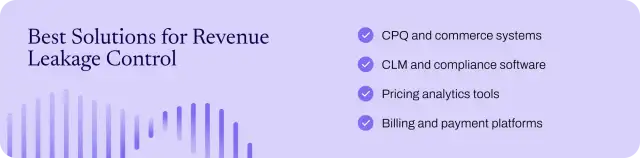
4 Technology and Analytics Solutions for Revenue Leakage Control
Revenue leakage often has multiple sources, and no single tool can close the gap on its own. The businesses that bring this problem under control connect their existing software to a system in which pricing, contracts, quoting, and billing share the same data and enforce the same rules.
Take a look at the four technology layers that make revenue leakage control possible:
1. CPQ and commerce systems for end-to-end revenue control and governance
An enterprise CPQ solution enforces the pricing model at the time of the quote, applies approval workflows, and pushes quote-level data into CRM, CLM, and billing without re-keying.
Unlike standard quoting utilities, a governed CPQ tracks all modifications made to the list price, including:
- The approvals that authorized it
- The configuration choices that shaped it
- The commitments the deal locked in
These details give finance the complete price waterfall it needs to run a credible leakage analysis, so they don’t need to track every deal history from emails and spreadsheets.
Discover what you need to look for in a CPQ technology stack.
2. CLM and compliance software for contract accuracy and enforcement
A connected contract management tool holds the structured version of commercial terms, exposes it to billing through APIs, and produces the compliance evidence auditors expect.
CLMs drive revenue assurance through three main features:
- Structured clause libraries that map to invoicing fields, so negotiated terms execute automatically
- Automated contract obligation management that fires on escalators and renewal dates without relying on calendar reminders or the finance team’s memory
- Exception workflows that route non-standard terms to the right approver before signature, stopping revenue risk at the contract stage
3. Pricing analytics tools for detecting margin and pricing leakage
A modern pricing analytics layer runs three things:
- A price waterfall across the active portfolio
- An outlier-detection model on new quotes
- A margin attribution model that connects pricing decisions to deal-level profitability
Legacy quarterly variance audits can’t keep pace with the opportunity anymore. Once you notice the gaps in the financial report, the next quote has already left with the same problem. AI-driven guardrails embedded in the quoting flow are the modern standard, since they convert your pricing data into a real-time control.
4. Billing and payment platforms for an integrated quote-to-cash execution
A connected invoicing system reads the contract structure, applies usage data on a clean cycle, runs subscription terms, and feeds collections without dropping information along the way.
Conga Billing enables quote-to-cash execution by offering key integrations with your CLM, CPQ, and collections systems, so you can manage structured contract terms and price configurations and automate invoice reminders in a single tool.
Best Practices to Strengthen Revenue Leakage Prevention
Preventing revenue leakage takes continuous work after the initial audit. Get started with these six best practices:
| Revenue Leakage Prevention Best Practices | How to Do It |
| 1. Run Price Waterfall Audits Across Quote-to-Cash Pricing Layers | 1.1 Execute a quarterly waterfall from list to net realized price, segmented by product family, channel, and account tier. 1.2 Pull all pricing layers, list, standard discount, deal-desk override, rebate, and payment terms into the same dataset. 1.3 Track variance month over month. |
| 2. Enforce Contract-to-Invoice Reconciliation for Commercial Agreements | 2.1 Build a structured comparison between active contract terms and the billing engine output. 2.2 Reconcile monthly at the contract-line level on price, volume, escalator, and renewal terms. 2.3 Flag any gap as an exception that routes to finance for resolution before the next invoicing cycle. |
| 3. Tighten Deal Desk Discount Governance Across Sales Approvals | 3.1 Codify approval thresholds by segment, deal size, and product family. 3.2 Route exceptions to a deal-desk workflow that captures the rationale and financial justification before the quote leaves. 3.3 Report discount variance by rep and segment monthly, so leadership spots patterns before they compound. |
| 4. Validate Cross-System Data Across the Revenue Stack | 4.1 Run automated reconciliation between CRM, CPQ, CLM, and billing for account hierarchies, product SKUs, and contract terms. 4.2 Flag mismatches as exceptions that block invoicing until resolved. 4.3 Schedule a weekly sync audit so gaps surface before they reach the invoicing run. |
| 5. Automate Billing Accuracy and Subscription Recovery Processes | 5.1 Audit all invoices against the contracted price, volume tier, and active promotions before they go out. 5.2 Run an automated card updater to fix failed payments at the source. 5.3 Configure retry logic with staggered intervals across the billing cycle. 5.4 Set up dunning workflows that escalate from email to account manager outreach. 5.5 Trigger proactive renewal outreach 60 days before expiration for any account showing usage decline or support activity. |
| 6. Deploy Real-Time Revenue Analytics and Anomaly Detection | 6.1 Embed pricing, margin, and discount dashboards into the daily operating rhythm of deal desks, sales leadership, and finance. 6.2 Run anomaly detection on all quotes to surface outliers before approval. 6.3 Set threshold alerts so finance receives automatic notification when realized margin on a deal falls below the segment floor. |
Stop Revenue Leakage by Aligning Your Commerce Chain with Conga
Conga lines up pricing, quoting, contracting, billing, and rebates on one connected platform. Every commitment a seller makes flows straight into the executable record that finance sees. Aime, our AI assistant, reads the patterns in your data and flags pricing variance, contract drift, and discount anomalies in the moment they happen, not in next quarter’s report. The result is a revenue leakage analysis that runs automatically, with an audit trail to prove it.
See how our solutions line up your whole commerce chain:
- Contract lifecycle management software: centralize all contracts in a searchable repository, track obligations and renewal dates automatically, and feed negotiated terms into billing so commercial commitments execute as agreed
- Smart CPQ: configure complex deals, enforce discount guardrails, and generate accurate quotes with AI-driven pricing recommendations that link to contracting and invoicing without manual re-entry
- Billing: generate invoice schedules from CPQ orders, manage subscriptions, upgrades, and renewals without manual intervention, and consolidate mixed models into a single invoice
- Price optimization: adapt pricing in real time based on the customer's own deal history, cost inputs, and business objectives, delivering consistent, margin-protected prices across all channels and transactions
Talk to our sales team to see how Conga connects revenue leakage analysis with everything you need to stop losing money on your next deals.
Stop revenue leakage with Conga’s unified platform
Related Resources
-
Pricing Opportunity Framework: See What You’re Leaving on the Table GuidesAIPricing Opportunity Framework: See What You’re Leaving on the Table
Estimate how much revenue your pricing process is losing and what it would take to recover it.03/30/20263 min read -
The Executive’s Guide to AI Pricing Optimization GuidesPrice Optimization & ManagementThe Executive’s Guide to AI Pricing Optimization
How AI pricing optimization transforms forecasting accuracy and protects revenue.03/10/20261 min read -
Conga Named Leader in the Gartner® Magic Quadrant™ for B2B Pricing and Rebate Optimization Software Analyst ReportIndustry InsightsConga Named Leader in the Gartner® Magic Quadrant™ for B2B Pricing and Rebate Optimization Software
See how Conga performed in the Gartner Magic Quadrant for B2B Pricing and Rebates Optimization.04/13/20262 min read -
Why AI-Powered Pricing is Now a Business Necessity for Margin and Growth BlogAIWhy AI-Powered Pricing is Now a Business Necessity for Margin and Growth
Learn why AI pricing is becoming essential for businesses facing rising market volatility, increased pricing pressures, and growing need for agility.06/30/20267 min read