From Automation to Intelligence: How AI is Redefining Modern Contracting
12/29/2025
7 min read

78%
of organizations use AI in at least one function
80%+
see no enterprise-level EBIT impact from AI
Nearly 1/3 of employees interact with contract data daily
Conga and Forsys cut contract cycle times by 42%
Contracts sit at the center of every business, touching everything from revenue and customer commitments to compliance, IP, supply chains, and people operations. In fact, on any given day, almost one-third of employees interact with contract data—yet the processes supporting these critical documents remain inconsistent, manual, and under-optimized in most organizations.
When contracting is treated as an administrative function instead of a strategic capability, the consequences are predictable: delayed deals, scope creep, revenue leakage, compliance gaps, and fractured customer experiences. These are not small issues—they directly influence topline growth, profitability, and brand trust.
The time has come for enterprises to evolve. Workflow automation alone can no longer keep up with rising commercial complexity and regulatory pressure. What businesses need now is AI-powered contract intelligence—a shift from pushing documents through steps to unlocking insights, predictions, and visibility across the entire contracting lifecycle.
In this blog, we explore why this transition is urgent and how Conga and Forsys together provide a uniquely powerful ecosystem to help organizations mature from basic automation to intelligent, data-driven contracting at scale.
When Contracts Fail, Business Risks Multiply
Picture this: It’s the peak of renewal season for a major SaaS company—the period when nearly 40% of annual recurring revenue is on the line. A strategic customer is set to renew, and everything seems on track… until they flag a discrepancy: the SLA uptime commitment in the renewal draft doesn’t match the language in a prior amendment.
Legal investigates and uncovers the root cause: a long-buried versioning error left an outdated SLA clause active across multiple agreements. That single mismatch now threatens not just one renewal, but millions in ARR, potential revenue-recognition issues under ASC 606, and the credibility of the contracting process itself.
What should have been a predictable, frictionless renewal instantly becomes a cross-functional fire drill. Teams scramble to identify where the clause exists, executives get pulled into escalation calls, and forecast stability starts to wobble at the worst possible moment.
This scenario isn’t an outlier—it’s a reflection of how fragile traditional contracting can be when organizations rely on manual processes, scattered templates, and limited visibility. And it’s exactly why businesses across industries are moving beyond basic workflow automation and embracing AI-driven contract intelligence to proactively detect risks before they become revenue-impacting crises.
The Case for Contract Intelligence: Why Workflow Automation Isn’t Enough
Let’s be clear: Contract automation was necessary. It allowed organizations to eliminate paper-based signatures; it ushered in standardized templates and approval routing. But even a well-built automated workflow can’t interpret obligations, spot hidden risks, or identify revenue opportunities buried in thousands of legacy agreements.
And as organizations’ contract volumes grow, manual review remains the bottleneck.
To move beyond bottlenecks and reactive processes, organizations need more than automation—they need contract intelligence.
- Also read: Leading healthcare platform provider relies on Forsys managed services for Conga CLM solution and reduces IT costs by ~25%.
The Limits of AI in Contracting
Over the last few years, AI tools have stepped in to help streamline and automate processes at several points in the contract lifecycle, aiding greatly in the drafting, negotiation, and monitoring of a contract portfolio. But here’s the catch: AI will only deliver when it is built on clean data, consistent templates, and integrated systems. Without these strong foundations, the impact of even the most advanced models will fall short of expectations.
Recent McKinsey research underscores this reality: Despite widespread AI adoption (78% of organizations use it in at least one function), more than 80% of respondents say their organizations aren’t seeing tangible enterprise-level EBIT impact from it. Value creation is happening in pockets (business units), but not across the enterprise.
To realize the full promise of AI-enabled contract intelligence, organizations need both insight and execution working together.
Conga + Forsys: Bridging the Divide
AI-driven contract intelligence goes beyond search and storage. Modern CLM platforms extract clause data, score risk, align terms to playbooks, surface obligations and renewal windows, and present analytics that show where revenue or risk is concentrated.
Conga: Intelligence Beyond Automation
Conga’s CLM product and platform capabilities are built for that job. They provide AI-based:
- Data intelligence: Clause and data extraction, metadata, structure
- Risk & negotiation intelligence: Risk detection, deviation scoring, playbook alignment
- Commercial intelligence: Renewals, obligations monitoring, revenue outcomes linkage
These capabilities let legal, sales, procurement, and finance act on the same information, negotiate with evidence, escalate high-risk contracts earlier, and tie contract terms to billing and revenue recognition flows.
With Conga, organizations don’t just automate contracts—they gain intelligence that reduces cycle times, mitigates risk, and speeds revenue.
- Also read: Conga and Forsys help teleco giant cut contract cycle times by 42%, reduce errors by 70%, accelerate approvals, and free teams to close deals faster.
Implementation Matters: The Forsys Difference
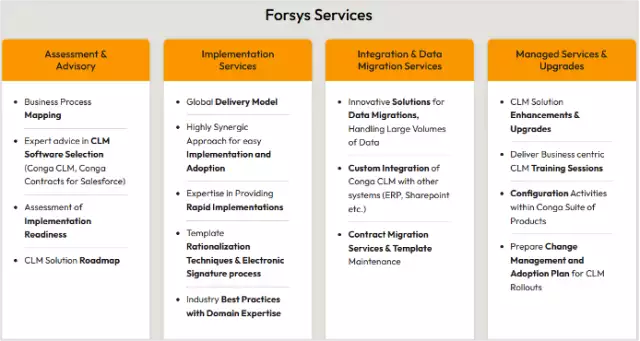
AI models are only as good as the data and processes they rely on. That’s where Forsys’s comprehensive lifecycle of CLM services proves essential. With Forsys, organizations can ensure contract data flows cleanly across Salesforce, CPQ, entitlement systems, and billing—so teams are always working with the right version, in the right system, at the right time.
And with Salesforce’s Agentforce, teams can extend that intelligence into AI‑powered customer engagement, ensuring contracts and conversations stay aligned.
Forsys drives intelligent contracting through a practical, implementation‑first maturity path—assessment, enablement, and intelligence—anchored in migration, rationalization, integration, and ongoing managed services.
In Closing
Modern contracting isn’t just about moving documents faster—it’s about transforming contracts into a strategic intelligence layer that accelerates growth, sharpens compliance, and protects every dollar of revenue. Conga delivers the platform and product. Forsys makes it real.
If you’re ready to eliminate risk, shorten deal cycles, and unlock the revenue trapped in your contracting process, let’s talk. It’s time to move beyond automation and step into true contract intelligence.
- Also read: How Forsys implemented Conga CLM for a $6B+ insurance leader—boosting contract accuracy by 45%.
Frequently Asked Questions
-
What is contract intelligence and how is it different from contract automation?
Contract automation moves documents through predefined steps: standardized templates, approval routing, and electronic signatures. Contract intelligence goes further. It uses AI to interpret obligations, score risk, align terms to playbooks, and surface renewal windows and revenue opportunities buried across thousands of agreements. Automation handles the process. Intelligence handles the insight.
-
Why isn't workflow automation enough for modern contracting?
Automation was a necessary first step, but it can't interpret what's inside a contract. As contract volumes grow, manual review becomes the bottleneck. A well-built automated workflow still can't spot a hidden risk, flag an outdated clause, or identify revenue trapped in legacy agreements. That's the gap contract intelligence fills, moving teams from reactive firefighting to proactive risk detection.
-
What does AI need to work well in contract lifecycle management?
Clean data, consistent templates, and integrated systems. AI models are only as good as the data they rely on. McKinsey research found that while 78% of organizations use AI in at least one function, more than 80% see no enterprise-level EBIT impact, largely because value stays trapped in pockets rather than scaling across the business. Strong data foundations are what turn AI from a demo into measurable results.
-
How does poor contract management create business risk?
A single versioning error can threaten millions. Consider a SaaS renewal where an outdated SLA clause, left active across multiple agreements, surfaces during peak renewal season. What should be a routine renewal becomes a cross-functional fire drill: threatened ARR, revenue-recognition issues under ASC 606, and shaken forecast confidence. Scattered templates and limited visibility make traditional contracting fragile at exactly the wrong moments.
-
How do Conga and Forsys work together on contract intelligence?
Conga delivers the CLM platform and AI capabilities: clause and data extraction, risk detection, playbook alignment, and obligation monitoring tied to revenue outcomes. Forsys handles implementation, making sure contract data flows cleanly across Salesforce, CPQ, entitlement, and billing systems so teams always work from the right version. One provides the intelligence, the other makes it operational at scale. Together they've helped clients cut cycle times by 42% and reduce errors by 70%.
Related Resources
-
Only the Agile Thrive BlogIndustry InsightsOnly the Agile Thrive
Discover how business agility, AI, and connected data help companies respond faster to tariff disruptions, reduce risk, and make confident go‑to‑market decisions.02/23/20265 min read -
Reimagine Commerce and Profitability with Conga on the Microsoft Azure Marketplace BlogAIReimagine Commerce and Profitability with Conga on the Microsoft Azure Marketplace
Discover Conga's AI-powered CPQ, CLM, Document Automation, and Pricing Optimization solutions now available on Microsoft Azure Marketplace.10/06/20266 min read -
Conga Named a Top CLM Provider in MGI Research Buyer’s Guide BlogCLMConga Named a Top CLM Provider in MGI Research Buyer’s Guide
Conga ranked among the top CLM providers in MGI Research’s 2025 Buyer’s Guide—earning an A rating for our AI-driven, enterprise-ready contract management platform.10/09/20254 min read -
AI Agents in Contracting: Digital Colleagues for Legal and Commercial Teams BlogAIAI Agents in Contracting: Digital Colleagues for Legal and Commercial Teams
AI agents are transforming contracting from manual, document‑heavy work into an intelligent, proactive discipline. In this blog, discover how agentic AI reshapes drafting, negotiation, renewals, workflow automation, and portfolio‑level insights—and why the Conga + Forsys partnership is uniquely positioned to help organizations operationalize these capabilities at scale. Learn how modern enterprises are cutting review time, improving compliance, and turning contracts into a strategic source of intelligence and advantage.02/03/20269 min read